Build Your 1770s Military Kit
Our Standard: Authenticity by Design
The 1st Virginia is committed to a high level of historical accuracy. Our clothing and gear is based on deep research into original 18th-century uniforms, accouterments, patterns, fabrics, and construction. This dedication ensures that when we take the field, we aren't wearing costumes—we are wearing authentic, historically correct uniforms.
The “New Recruit" Safety Net
Know that achieving a high-quality Military Kit takes time and financial investment. You don't have to do it all on day one.
Don't Buy Twice: We maintain an inventory of reproduction, and historically correct fabrics, as well as other materials from vetted sources to outfit our soldiers. Because we buy in bulk, this will save you time and money, and insure your military kit is as authentic as possible. Please coordinate with the Unit Quartermaster before making any external purchases.
The Loaner Locker: Because it will take time to assemble your authentic uniform, we maintain an inventory of clothing and gear specifically for the use of our new members. This allows you to participate at our events immediately while you build your own kit at your own pace. Use the Loaner Locker for up to a year, replacing loaner items as you acquire you’re own.
The Goal: We believe the satisfaction of a truly authentic impression is well worth the effort.
The Quartermaster’s 12-Month Roadmap
Phase 1: The “Recruit" Essentials (Months 0–3)
Goal: Get into the field using the Loaner Locker while securing your own personal basics.
The "Loaner" Kit: Meet with the unit members who manage our Soldier’s Loaner Locker. Utilize the unit’s shared gear while you learn the ropes.
First Purchases: Soldiers will purchase a canteen, plus basic eating utensils from the unit’s Quartermaster (QM). We expect soldiers to arrive on the Parade Ground with a correct, and full canteen of water.
Footwear: Proper 18th-century shoes (leather, grain-out), plus buckles are the standard for Soldiers and Civilians. We will direct you to the correct source.
Military “Cocked Hat”: Soldiers will purchase the correct style soldier’s hat from the unit supplier, complete with the correct binding and military style cockade, based on years of research.
Phase 2: The “Virginia" Look (Months 4–8)
Goal: Transition away from the loaner locker and into your own unique 1st Virginia identity.
Overalls (gaitered trousers): The first item of clothing to be purchased are the preferred Continental Army gaitered trousers, called “Overalls” by American soldiers. More efficient and sturdy than civilian breeches and stockings, Overalls fit very snug through the legs and are finished at the ankle like modern spats to cover the shoe and buckle.
Hunting Shirt: The loose fitting, fringed, linen hunting shirt was issued to Continental soldiers throughout the War. This distinctive garment was easy and cheap to make, alter, and clean, creating a sense of uniformity and esprit d’corps for Washington’s Army in the early years.
Body Shirt: The basic, loose fitting, white linen shirt, considered your 18th c. underwear, fits loose, with only the collar and cuffs exposed when a soldier is fully dressed.
Waistcoat: Essential to men’s dress in the 18th c., this was part of the soldier’s standard uniform among the armies of Europe and America.
Phase 3: The “Fully Equipped" Member (Months 9–12+)
Goal: Complete your kit with the “Big Ticket” items for Parade promotion from “Recruit,” to “Private.”
Regimental Coat: This coat distinguished the soldier as a member of the professional Continental Army, and set him apart from the civilians that made up the “militia.” Made of imported wool broadcloth, this will be tailored to fit the soldier, just as the originals were.
“Napsack-Haversack”: Dating to 1776, and based on a period document, this specific style knapsack was issued to troops from Virginia.
The Finishing Touches: Blanket, reproduction American style leather accouterments, and period-correct personal effects.
Readiness: You are now fully equipped to represent the 1st Virginia soldier on Parade, and in the field.
Steve
Quartermaster
(Accouterments & Gear)
Chip
Quartermaster
(Clothing)
Questions?
Whether you are enlisting as a First Virginia soldier or joining our camp civilians, our Quartermaster team is here to guide you to the right sources. Please reach out to them before you place an order, cut any fabric, or purchase a “modern equivalent.” We are here to ensure your 18th century clothing and gear is authentic, fits correctly, and cost-effective from day one.
Already purchased something? We’ll take a look, determine whether your item is appropriate, period correct, and can be used at our events.
When to reach out:
You’re ready to start Phase 1 by purchasing your first items, or transition into the next phase.
You want pricing for “Unit Supply" items, including fabric, gear, tailor-made clothing.
You found a piece of gear and want to verify it’s “period correct.”
You want to speak to our 18th-century tailors and craftsmen.
Sourcing Your Gear: The “Unit Supply" Advantage
To ensure every member is authentically uniformed and equipped, maintaining our high standards, most items are sourced through the unit, using our designated Regimental tailors. This ensures your kit is historically accurate, properly fitted, and cost-effective.
Why we handle this internally:
Authenticity Guaranteed: We ensure every piece uses verified 18th-century patterns and correct materials.
Expert Construction: Uniform clothing and accouterments are crafted by vetted “period-expert” tailors, and experienced unit members.
Bulk Savings: Unit ordering allows us to leverage bulk discounts, saving you money.
Faster Turnaround: Streamlined sourcing helps you get into the field sooner.
Soldier Standards
-
Regimental Coat: The coat is made from high quality dark blue and madder red wool Broadcloth with a smooth finish. Coats are patterned after the well-documented 1779 Regulations as ordered by the Continental Congress. The wool coat is constructed with raw edges (except where noted), lined with serge and linen, and hand finished. The materials should be purchased from the Quartermaster (QM) and made either by one of our approved tailors or according to our detailed instructions. The unit can provide help and guidance for members planning to make their own coat and other garments.
-
-
-
-
-
-
-
Finished Kit
-
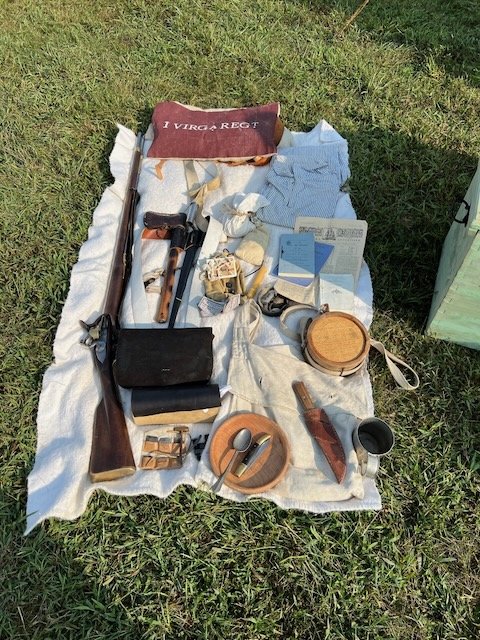
Cartridge Box: Soldiers carry a reproduction of the Late War “Congress” box. Our cartridge boxes are made by unit members and offered through the QM.
Bayonet Carriage: The QM offers finished bayonet slings with a heart-shaped frog, believed to date from the War. A “double-frog” sling in kit form is also available.
Musket: Italian (Pedersoli) and Japanese (Miroku) reproduction muskets are allowed; no India-made muskets are permitted for safety reasons. The QM must approve muskets of other manufacture prior to using on the field.
-
Haversack: Our haversack is based on the original British item in the Craig Nanos collection. It is sold as a kit for soldiers to make.
Knapsack: Soldier sling the “New Invented Knapsack-Haversack” carried by troops from Virginia as documented in the Maryland Historical Society collection. The QM offers this as a kit to be completed by the member. The unit holds periodic workshops to assist in finishing the kit.
-
Item dFacial Hair: Continental Army soldiers were clean-shaven. Common practice for soldiers was to shave at least every two or three days, on special parade days, and for guard duty. Goatees, mustaches, beards or any other creative facial hair is frowned upon as not common for the period.
Hair: The common hairstyle for soldiers was typically tied in a queue, braided, or clubbed. Shorter styles were not unheard of, especially for farmers and tradesmen. At least one order for Virginia’s Continental soldiers, appearing in the Orderly Book of the 6th Virginia Regiment, stipulates that the soldier’s hair should be cut short and all to the same length.
Some members choose to wear their hair long or purchase a wig to enhance their 18th-century military appearance. If your hair or wig is long enough, it should be tied back with a leather thong, or a black ribbon of linen, silk, or wool tape.escription
First Virginia Soldiers portray the Musket Company as prescribed by the Continental Congress in 1779. We know some details about this uniform from primary source documentation. Gaps in our understanding have been filled by comparable items based on well-documented examples from the period.